






Solvent vs. Aqueous: Which Is Right for Your Component Cleaning?
Solvent vs. Aqueous: Which Is Right for Your Component Cleaning?
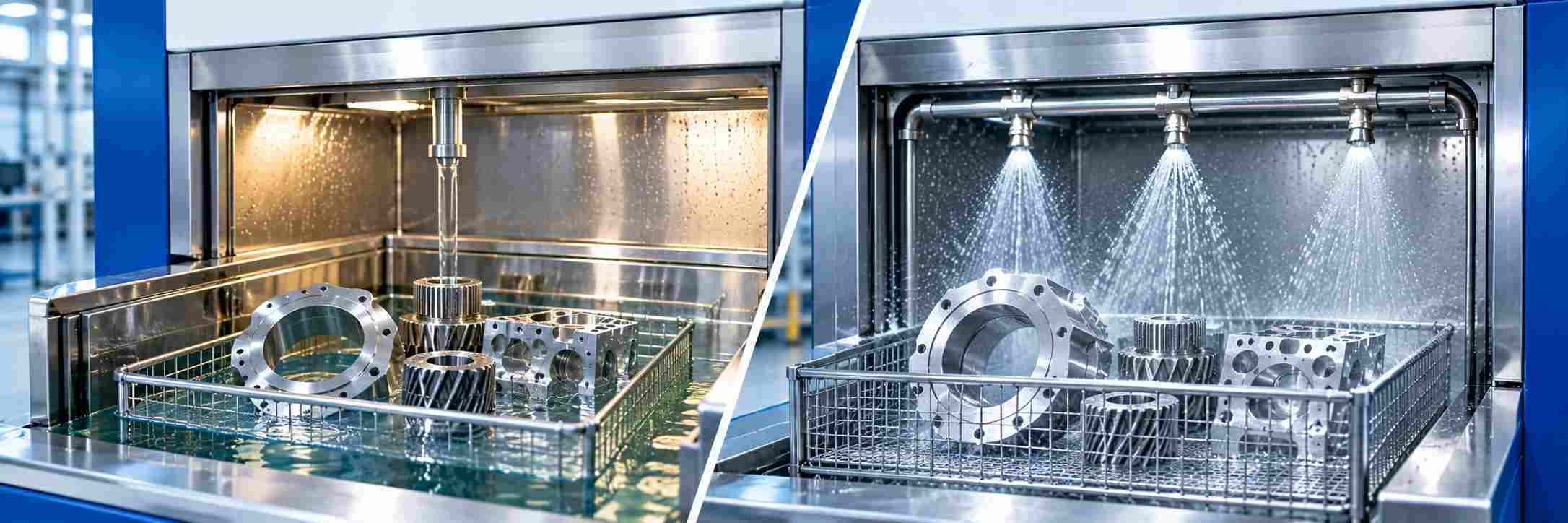
Solvent and aqueous are the two families of cleaning media used in industrial parts washers. One uses solvents, such as hydrocarbons or modified alcohols. The other uses water combined with detergents. That is the whole difference. Neither one is a machine type, and neither one is "better" in general.
What decides the choice is the job in front of you: the contamination, the component geometry, the material, the cleanliness requirement and the production environment.
So the useful question is not which medium wins. It is this: which medium can reliably deliver the required cleanliness on this component, under real production conditions?
One more point before we get into it. Ultrasonic cleaning is not a third option sitting beside solvent and aqueous. It is a mechanical process, and it can be added to either medium. We cover it in its own section below, because mixing the two ideas up is the most common source of confusion when manufacturers compare systems.
Solvent Parts Cleaning: Strong on Oils and Grease
Solvent parts cleaning relies on solvents chosen for their ability to dissolve oils, greases and other organic contamination. Depending on the system, industrial solvent cleaning can include spray cleaning, immersion, vapor degreasing and vacuum drying, all inside a vacuum-tight chamber.
Solvent media tend to suit applications where:
- Oil and grease are the main contaminants
- Complex geometries need good penetration
- Residual moisture must be avoided
- Fast, complete drying is required
- High cleanliness is needed
Ecoclean's solvent cleaning systems work with hydrocarbons or modified alcohols and combine cleaning and drying steps in one chamber. TheEcoCcompact family is our focus for solvent parts cleaning, and theEcoCbase gives smaller operations an efficient way into solvent cleaning when capacity needs are modest.
Solvent selection still takes care. It has to account for the contaminant, the component material, process conditions, system design, regulatory requirements and solvent management.
Aqueous Parts Cleaning: Flexible Across Many Processes
Aqueous parts cleaning uses water plus detergents or other chemistry matched to the contamination. It is a good fit for a wide range of general and precision manufacturing work, particularly where coolant, emulsions, particulate and other production residues need to come off.
The point many buyers miss is that an aqueous process is much more than the wash stage. The full sequence looks like this:
Cleaning → rinsing → drying → handling
Water quality, bath condition, temperature, filtration, mechanical action and drying all shape the final result. A weak rinse or a poor drying step can undo a good wash.
For manufacturers looking at aqueous parts washers, theEcoCvertex shows how spray and flood cleaning, several cleaning stages, filtration and drying can sit together in a single system.
Ultrasonic Cleaning: A Mechanical Process for Either Medium
Ultrasonic cleaning describes how energy gets into the part. It is not a cleaning medium. High-frequency sound waves in the cleaning liquid create cavitation, tiny collapsing bubbles that loosen contamination from surfaces. That effect works in an aqueous bath and in a solvent bath.
It helps most where geometry makes contamination hard to reach:
- Blind holes
- Narrow passages
- Cavities and recesses
- Fine structures
- Complex internal geometries
So the real process is always a combination:
Cleaning medium (solvent or aqueous) + mechanical action (spray, immersion, ultrasonics, pressure) + component geometry + contamination + process parameters
Ecoclean'sultrasonic multi-stage immersion systems show this in practice. Multiple stages handle controlled cleaning, rinsing, passivation and drying, and the ultrasonic energy is applied within whichever medium the application calls for.
Ultrasonics has limits of its own. Results depend on part positioning, liquid condition, ultrasonic power and frequency, and whether the sound can actually reach the contaminated surface.
Where Each Choice Reaches Its Limits
Every option involves trade-offs.
- Solvent cleaning degreases very well, but needs careful attention to solvent chemistry, equipment design, regulatory requirements and solvent management.
- Aqueous cleaning is flexible, but rinsing, water management and drying become part of the system design.
- Mechanical processes, ultrasonics included, add cleaning action, but they do not fix a medium that is wrong for the contamination.
The goal is not the most aggressive process. It is the one that matches the application.
The Component Often Decides
Take two machined parts.
The first has open, accessible surfaces and a heavy oil film. A solvent cleaning machine with controlled drying may do the job cleanly and quickly.
The second has narrow internal passages where contamination hides. Turning up the spray pressure will not fix that. Immersion, ultrasonic energy or pressure-assisted cleaning, with either medium, is the better path.
Same factory, same oil, very different answers. Geometry, contamination, material and cleanliness requirements set the challenge, so both the medium and the mechanical process should be judged against the actual component rather than picked in isolation.
Industry Changes the Requirement
The application also shapes the process:
- Automotive and e-mobility: high volumes, short cycle times, automation and technical cleanliness drive system design.
- Aerospace: complex geometries and sensitive materials call for tight control of media and drying.
- Medical technology: reproducibility, validation, documentation and controlled handling become part of the cleaning process.
- High-purity manufacturing: particulate control, residues, drying and media quality often call for more specialized systems.
Ecoclean's portfolio covers general industrial cleaning through to precision and high-purity work, using different media and mechanical processes.
How to Choose: Six Questions
Before settling on a solvent system, an aqueous system, or the mechanical process added to either, work through these:
- Contamination: What has to come off: oil, grease, chips, particles, emulsions, or a mix?
- Part geometry: Are the dirty surfaces open, or are there internal passages and cavities?
- Material: Is the cleaning medium compatible with the component and its surface finish?
- Cleanliness requirement: What level does the next process or final application demand?
- Drying requirement: Can some moisture remain, or does the part need controlled, complete drying?
- Production conditions: What are the throughput, cycle time, batch size, automation and handling needs?
Taken together, these answers usually make the choice of medium clear, and show whether a mechanical add-on like ultrasonics is worth including.
Test Before You Commit to Equipment
For demanding parts, a cleaning trial settles what a spec sheet cannot.
Ecoclean's Test Center in Southfield, Michigan runs trials on aqueous and solvent chamber systems and on ultrasonic immersion systems. Testing can cover spray and flood cleaning, vapor degreasing, ultrasonic cleaning, Pulsated Pressure Cleaning and different drying technologies. Cleanliness testing and analysis to VDA 19 Part 1 / ISO 16232 are also available.
If you need to prove a process or cover a gap,contract cleaning is another route. It suits process validation, production ramp-up and finite production batches and lets you outsource a cleaning step for a period.
Final Thoughts
Solvent and aqueous are the two media. Ultrasonic is one of the mechanical processes that can be used with either. Treating them as three rival technologies leads to the wrong comparison.
Solvent parts cleaning is highly effective on suitable oils and greases. Aqueous parts cleaning gives flexible, water-based options for many manufacturing applications. Ultrasonics adds mechanical energy that helps with complex or hard-to-reach geometries, in either medium.
The decision comes down to:
Contamination → geometry → material → cleanliness requirement → drying → production conditions
Need help evaluating your cleaning process?
Contact Ecoclean North America →
Ecoclean Group US
Head Office: 26801 Northwestern Highway 48033 Southfield, Michigan, USA
Call: +1 947 272 0600
Mail: info.usa(at)ecoclean-group.net
Service: +1 855 200 3877 | service.usa(at)ecoclean-group.net
Frequently Asked Questions
Q. 1. What is solvent parts cleaning?
A. Solvent parts cleaning uses solvent-based media, such as hydrocarbons or modified alcohols, to remove oils, greases and other organic residues from manufactured components. Depending on the system, the process can include spray cleaning, immersion, vapor degreasing and vacuum drying.
Q. 2. When should manufacturers choose aqueous parts cleaning?
A. Aqueous parts cleaning suits many industrial applications involving coolants, emulsions, particulate and other production residues. The process combines cleaning, rinsing, filtration and drying, set up around the component and the required cleanliness.
Q. 3. Is ultrasonic cleaning a third option next to solvent and aqueous?
A. No. Solvent and aqueous describe the cleaning medium. Ultrasonic cleaning is a mechanical process that can be used with either one. It adds cleaning action for complex geometries and hard-to-reach surfaces, but the medium still has to suit the contamination.
Q. 4. Which cleaning approach is best for complex component geometries?
A. There is no universal answer. Parts with blind holes, internal passages, cavities and fine features often benefit from immersion, ultrasonic energy, pressure-assisted processes, or a combination, using either a solvent or an aqueous medium. The right choice should be checked on the actual component and contamination.
Q. 5. How can I find out which cleaning system is right for my parts?
A. Start with the contamination, material, geometry, required cleanliness, drying needs, throughput, cycle time and automation. Then run a cleaning trial on production components to confirm the process before you select equipment.


