




Industrial Parts Cleaning Equipment: A Manufacturer’s Guide to Choosing the Right System
Industrial Parts Cleaning Equipment: A Manufacturer’s Guide to Choosing the Right System
Why the right cleaning system starts with the component, contamination and production process, not simply with the machine?
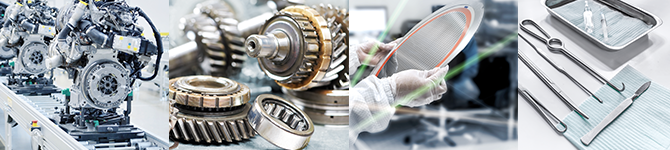
Industrial parts cleaning is an essential step in many manufacturing processes. Components may leave machining, forming, grinding, casting or other operations carrying oils, coolants, chips, emulsions and particulate contamination.
What happens next depends on the application.
Some parts require straightforward intermediate cleaning before another production step. Others need controlled cleaning before assembly, coating, heat treatment, bonding or packaging. Complex components may contain blind holes, internal passages, cavities or narrow geometries where conventional cleaning methods can reach their limits.
This is why choosing industrial parts cleaning equipment is not simply a matter of comparing machine types. The equipment needs to match the component, contamination, required cleanliness, throughput and production environment.
What Industrial Parts Cleaning Involves?
Manufacturing parts cleaning is the controlled removal of contamination generated during production.
The cleaning task can involve removal of:
- Oils, greases and lubricants
- Coolants and emulsions
- Metal chips and fine particles
- Grinding and polishing residues
- Process-related films and deposits
The required cleanliness level can vary considerably between applications. A general manufacturing component may require reliable removal of machining residues, while precision or high-purity applications can require much tighter control of particulate and surface contamination.
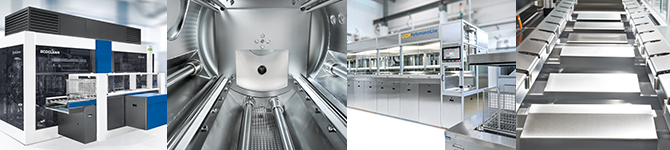
Ecoclean's industrial cleaning portfolio reflects this range, using water-based media and different solvent technologies together with spray, immersion, ultrasonic, vapor degreasing, injection flood washing and other processes.
Why the Component Comes First?
Before selecting industrial cleaning equipment, manufacturers should examine the component itself.
Geometry is one of the first considerations. A relatively open surface may be accessible to direct spray cleaning, while blind holes, cavities, threads and internal passages may require immersion, agitation, ultrasonic energy or pressure-assisted processes.
Material also affects process selection. Cleaning media, temperature, pressure and mechanical action need to be compatible with the component and its surface condition.
Then there is contamination. Oil, grease, chips, emulsions and fine particles do not necessarily respond to the same cleaning conditions.
Finally, manufacturers need to define the production requirement: batch size, throughput, cycle time, shifts, automation, available floor space and integration with upstream and downstream processes.
The right cleaning system comes from these requirements.
The Main Equipment Categories
Batch Cleaning Systems
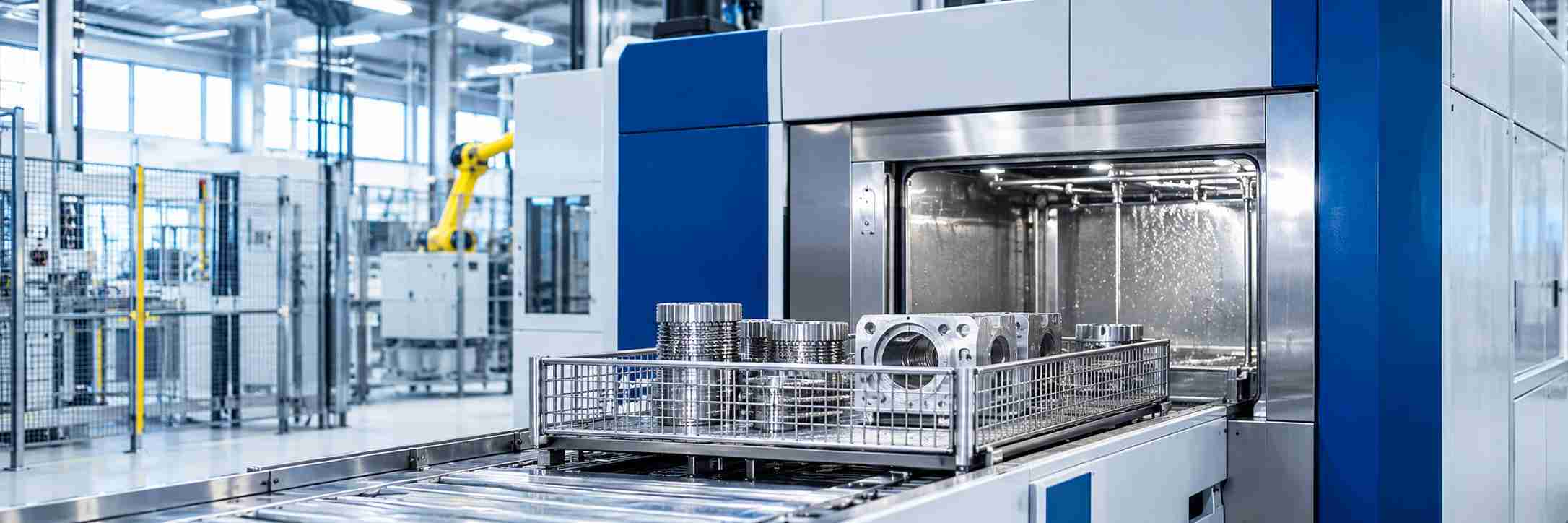
Batch systems process groups of components together using baskets, racks or fixtures.
They can be useful when manufacturers handle multiple part types, variable production quantities or different cleaning programs. Batch concepts can also provide flexibility where a continuous production line is not necessary.
Automated Parts Cleaning Systems
As production volumes increase, cleaning can become part of an automated manufacturing flow.
Automated parts cleaning systems can incorporate loading, transfer, cleaning, rinsing, drying and unloading while connecting with surrounding production equipment.
The objective is not automation for its own sake. Properly integrated automation can improve process consistency, reduce manual handling and help maintain predictable cycle times.
Single-Part and Robotic Systems
Some components are better processed individually rather than in batches.
Single part cleaning systems and robotic parts cleaning systems can provide controlled positioning and handling while integrating cleaning or deburring into an automated cell.
This approach can be relevant where component geometry, weight, orientation, production sequence or cleaning requirements make batch processing less suitable.
Ecoclean's technology portfolio specifically includes single-piece cleaning with robotic cells as well as batch systems for different industrial applications.
How Cleaning Action Changes the Equipment Choice
Equipment category alone does not determine cleaning performance. The way mechanical energy reaches the contamination is equally important.
Spray cleaning directs the cleaning medium onto accessible surfaces and is well suited to applications where direct contact with the contamination can be achieved.
Immersion cleaning surrounds the component with cleaning medium and can be combined with agitation to improve access to complex areas.
Ultrasonic cleaning uses acoustic energy and cavitation to create additional mechanical cleaning effects. It can be valuable for complex geometries, recesses, and difficult-to-reach surfaces.
For particularly demanding applications, Ecoclean also combines technologies such as ultrasonic cleaning and vacuum-assisted Pulsated Pressure Cleaning with different chamber and immersion concepts.
The important question is therefore not simply, “Which machine is most powerful?”
It is:
“Which cleaning mechanism can reliably reach the contamination on this component?”
Aqueous or Solvent Cleaning?
Cleaning chemistry is another fundamental equipment-selection decision.
Aqueous cleaning uses water-based media with a detergent or other cleaning agent and can be combined with spray, immersion, ultrasonic cleaning, rinsing, filtration and drying.
Solvent cleaning can provide an alternative approach for applications involving oils, greases and other contaminants where solvent-based processes are appropriate.
The choice should be based on the complete application:
Contamination + component material + geometry + cleanliness requirement + throughput + drying requirement
There is no universal cleaning medium that is correct for every manufacturing process.
Throughput, Automation and Production Flow
A cleaning system also has to keep pace with production.
For variable production or multiple component types, flexible batch parts cleaning equipment may be appropriate.
For higher-volume manufacturing, continuous or highly automated industrial parts cleaning systems may provide better integration with production flow.
Manufacturers should consider:
- Required parts per hour
- Batch size
- Cycle time
- Loading and unloading
- Automation level
- Floor-space availability
- Drying requirements
- Downstream handling
A technically effective cleaning system can still become a production constraint if its cycle time, loading method or handling concept does not fit the surrounding manufacturing process.
When a Custom System Makes Sense
Standard systems can cover many applications. Some requirements, however, call for a more individualized approach.
Custom parts cleaning systems become relevant when component size, geometry, contamination, cleanliness requirements, cycle time, automation or production conditions cannot be accommodated reliably or economically by a standard configuration.
Ecoclean states that custom systems can combine process technologies, media treatment, specialized handling, robotic or gantry systems and process monitoring around the specific component and production environment.
The objective is not simply to create a more complex machine.
It is to create a cleaning process that fits the manufacturing operation.
Selecting the right cleaning system is a not a simple task and the items explained above are just a high level overview of some aspects that are taken in consideration. It is really important to evaluate the entire production chain to find the best solution. The text above is not an all inclusive guideline.
A Practical Selection Framework
Before choosing industrial parts cleaning equipment, manufacturers should answer five questions:
Q. 1: What are we cleaning?
A: Define material, dimensions, weight, geometry and sensitive surfaces.
Q. 2: What are we removing?
A: Identify oils, grease, chips, particles, emulsions and other residues.
Q. 3: What cleanliness level is required?
A: Connect the cleaning result to the next manufacturing process and component function.
Q. 4: How much must be processed?
A: Consider batch sizes, parts per hour, shifts and future production requirements.
Q. 5: How will cleaning integrate into production?
A: Evaluate loading, automation, drying, handling, inspection and downstream operations.
These questions help manufacturers compare industrial cleaning systems based on the actual process instead of simply comparing machine categories.
Final Thoughts
There is no single best solution for industrial parts cleaning.
Batch equipment, automated systems, robotic cells, single-part washing systems, spray and immersion processes, ultrasonic technologies and customized component cleaning systems can all have a place in manufacturing.
The right choice begins with the component and works outward:
Component → contamination → cleaning process → required cleanliness → throughput → production integration
That approach gives manufacturers a more reliable foundation for selecting industrial cleaning equipment that supports consistent quality and efficient production.
Ecoclean North America provides industrial parts cleaning technologies and application expertise for manufacturers across a wide range of industries.
Ecoclean Inc.
26801 Northwestern Highway
48033 Southfield, Michigan, USA
Head Office: +1 947 272 0600
Email: info.usa(at)ecoclean-group.net
Service: +1 855 200 3877
Email: service.usa(at)ecoclean-group.net


