






Ask any plant manager what went wrong with a cleaning line and you will hear a familiar story. The machine was bought on a spec sheet, installed and then struggled with the real parts, the real oils and the real production rate.
After many years around parts cleaning projects, we can tell you the pattern is almost always the same. The problem did not start at the washer. It started before anyone bought one, when the application was not looked at closely enough.
A dependable industrial parts cleaning process begins with the right evaluation. Five factors decide almost everything: the material, the component geometry, the type of contamination, the required cleanliness level, and throughput. Get these straight first, and the choice of cleaning technology becomes far easier.
Why Evaluation Comes Before Equipment
It is tempting to start with the technology: spray, ultrasonic, solvent, vacuum or something else. But every method is a trade-off. What works well on a simple steel bracket may damage a soft aluminum part or fail completely on a deep blind bore.
A proper evaluation helps you:
- Match the cleaning technology to the part and the production need
- Avoid paying for performance you do not need
- Avoid buying a system that cannot reach the cleanliness your customer demands
- Reduce rework, scrap and late-stage surprises
Think of it as a short checklist you complete before you talk about machines.
Factor 1: Type of Material
The material decides what your parts can handle. Steel, cast iron, aluminum, magnesium, copper alloys, plastics and coated surfaces all react differently to cleaning media, temperature and mechanical energy.
What to check:
- Is the material sensitive to water, alkaline or acidic cleaners? Aluminum, for example, can stain or etch in the wrong chemistry.
- Can it take heat for washing and drying or will it distort?
- Is it prone to flash rust after aqueous cleaning, which means you need corrosion protection or fast drying?
- Are there seals, plastics or coatings that certain solvents will attack?
A cleaning process that is perfect for one alloy can ruin another. Always bring the material data to the first conversation.
Factor 2: Component Geometry
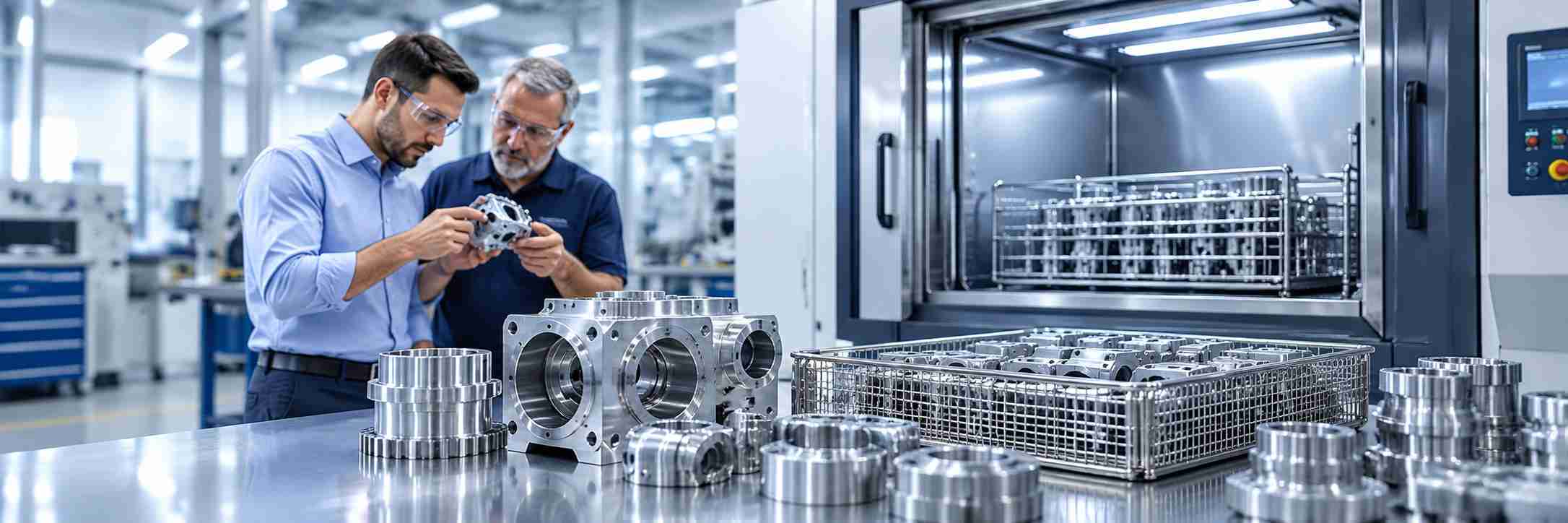
Shape is where many projects get hard. A flat plate is easy. A crankcase, valve body or injector housing with cross-drilled holes, blind bores, threads and internal channels is a different story.
What to check:
- Blind holes and deep bores where fluid can get in but contamination cannot easily get out
- Internal channels that need flushing, not just spraying
- Undercuts, ribs and shadowed areas that a spray cannot reach directly
- Part size and weight and how the part will be held, fixtured or moved
- Whether parts can nest or trap fluid and need special orientation or draining
If the cleaning medium cannot physically reach the contamination, nothing else matters. Geometry often decides the method more than any other factor.
Factor 3: Type of Contamination
You cannot choose a cleaning process until you know what you are removing. Contamination comes in many forms and each one has a different answer.
Common types:
- Oils, greases and coolants left from machining
- Chips, swarf and burrs from cutting and deburring
- Polishing and grinding residues
- Particles and dust picked up in handling and storage
- Films and fingerprints that matter for coating, bonding or optics
- Corrosion protection oils from earlier steps
Often it is a mix. For example, a machined part may carry oil, chips and fine particles at the same time. In that case, the process may need more than one cleaning stage, such as coarse cleaning first, then fine cleaning.
Knowing exactly what is on your part, and where it comes from, saves a lot of trial and error later.
Factor 4: Cleanliness Level Requirement
This is the factor that sets the finish line. How clean does the part really need to be?
Requirements range from simple visual cleanliness to strict technical cleanliness, where the number and size of residual particles are measured against a limit. In automotive and other demanding sectors, this is commonly checked through particle analysis and cleanliness testing in line with standards such as VDA 19 and ISO 16232.
What to check:
- What is the specified limit, and who set it: your customer, a standard, or your own quality team?
- Is it about particles, film residue or both?
- Does the part go into a sensitive assembly, or a coating or bonding step?
- How will you prove the result? A requirement you cannot measure is hard to defend.
A higher cleanliness level usually means a more advanced process, cleaner surroundings and tighter handling after cleaning. Over-specifying adds cost. Under-specifying leads to failures. The goal is to match the requirement honestly.
Factor 5: Throughput
A process can clean beautifully and still be wrong for your plant if it cannot keep pace with production.
What to check:
- How many parts per hour or per shift do you need to clean?
- Will it be batch cleaning, or continuous and in-line with machining?
- How much floor space and integration with the line is available?
- How will parts be loaded, unloaded and moved through?
- Do you expect volumes or part variants to grow?
Throughput also affects cost per part. A well-matched system cleans at the rate your line needs without sitting idle or becoming the bottleneck.
Putting the Five Factors Together
None of these factors stand alone. A hard-to-reach geometry combined with a strict cleanliness level will push you toward a very different solution than a simple part with a basic requirement.
Here is a simple way to work through it:
- Document the part: Material, drawings, geometry and critical surfaces.
- Identify the contamination: What it is, where it comes from, how much.
- Define the target: The cleanliness level and how you will test it.
- Set the production needs: Volumes, cycle time and line integration.
- Review the options with a specialist: Then test on real parts when you can.
Cleaning trials on actual components are worth their weight in gold. They show how the process really performs before you commit.
Common Mistakes We See in the Field
- Choosing equipment from a brochure before looking at the parts
- Ignoring upstream processes, such as poor pre-cleaning after machining
- Setting a cleanliness level without a way to measure it
- Forgetting about drying, handling and packaging after cleaning
- Sizing for today's volume and not tomorrow's
- Leaving the operators out of the discussion
A cleaning process is only as good as the whole chain around it.
Talk to Cleaning Experts Before You Decide
Every application is different, and the right answer depends on your component, your contamination, your cleanliness requirements and your production needs. At Ecoclean, we work through these questions with manufacturers every day, and we help them find the cleaning technology that actually fits.
Get the Right Cleaning Solution |Explore Industrial Cleaning Systems |Learn About Cleanliness Testing
call:- +1 947 272 0600
Email:- info.usa(at)ecoclean-group.net
Website:- ecoclean-group.us
Frequently Asked Questions
1. What factors decide the right industrial parts cleaning process?
A. Five factors matter most: the type of material, the component geometry, the type of contamination, the required cleanliness level and the throughput. Looking at these first helps make sure the cleaning technology suits both the part and the production setup.
2. Why does component geometry matter so much in parts cleaning?
A. Because cleaning media has to physically reach the contamination. Blind holes, cross-bores, threads and internal channels are hard to clean with simple spraying, so these parts often need targeted flushing, specific part orientation or a different technology altogether.
3. How do I know what cleanliness level my parts need?
A. Start with your customer drawing, specification or industry standard. In many automotive and precision applications, cleanliness is measured by particle size and count, often following VDA 19 or ISO 16232. If no requirement exists, work with your quality team to define one that matches how the part is used.
4. Can one cleaning process handle different materials and contaminations?
A. Sometimes, but not always. A mix of materials or contamination types may call for a multi-stage process or a flexible system with adjustable parameters. It is best to test representative parts before deciding.
5. Should I test my parts before buying a cleaning system?
A. Yes, whenever possible. Trials on real components show how the process handles your material, geometry and contamination and they give you measured results to compare against your cleanliness requirement. It lowers risk and avoids costly changes after installation.
Final Thoughts
The best cleaning process is not the most advanced one. It is the one that fits. By looking at the material, geometry, contamination, cleanliness level and throughput first, you give yourself a clear path to a solution that cleans reliably and keeps production moving.
Not sure where to start?


