






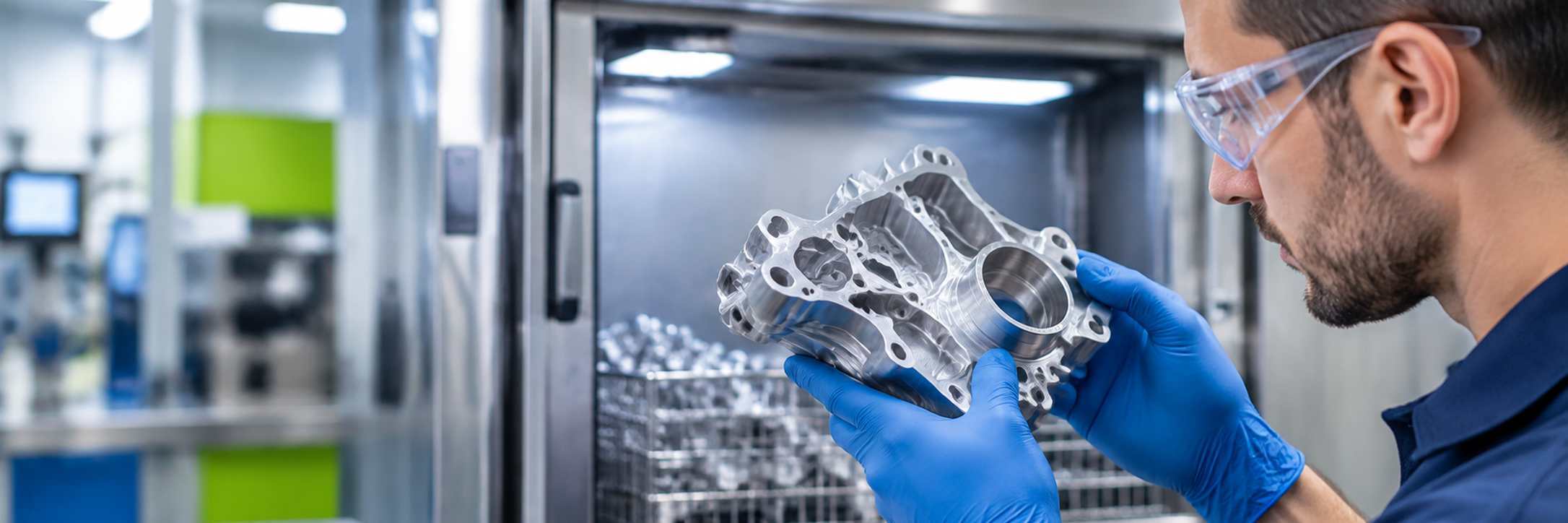
Cleanliness Standards, Testing and Validation: What Manufacturers Need to Know, showing a gloved technician holding a cleaned metal component
There was a time when "clean" meant a part that looked clean. No oil on the surface, no chips in the pockets, and it passed a quick look under the shop lights.
That time is gone. Today, for a great many components, cleanliness is a defined quality characteristic. It can decide whether a fuel system runs smoothly, whether a coating sticks, or whether an assembly survives its warranty period. As geometries get more complex and specifications get tighter, a casual approach to cleaning no longer works.
This guide walks through what we have learned over many years of cleaning projects: how to define technical cleanliness, how testing turns it into data, why validation is more than buying a machine, and how to take a cleaning trial all the way into a stable production process.
Defining Technical Cleanliness
A dependable cleaning process starts with one plain question: what does "clean" mean for this component?
The answer is rarely just "no visible dirt". Depending on the part, the requirement can include limits for:
- Particulate contamination (how many particles, and how large)
- Residual oils and greases
- Films and other process residues
Those limits depend on the component itself, its material, its geometry, where it will be used and how it was made.
Standards such as VDA 19.1 and ISO 16232 give manufacturers a framework to evaluate technical cleanliness. They tell you how to extract and analyze contamination in a consistent way. What they do not do is decide your limit for you. The cleanliness specification still has to reflect what the component needs to do in the real world.
One point deserves repeating. A part that looks clean can still carry microscopic particles or a thin film that causes trouble later. That is why measurement has to go beyond visual inspection.
Testing Turns Cleanliness into Measurable Data
Testing is how you find out whether your cleaning process is actually hitting its target.
In practice, this often starts with cleaning trials on original, contaminated components. These trials can be combined with cleanliness analysis and material compatibility testing to work out the right cleaning technology and the right process parameters.
For particulate contamination, the particles are extracted from the part and analyzed for characteristics such as size and quantity. You end up with objective numbers you can compare directly against the specified limit.
That is the real shift. You move from "the part looks clean" to "the process has demonstrated the required cleanliness". One statement is an opinion. The other you can defend to a customer or an auditor.
If you want a closer look at the measurement side, see our guide on particle analysis and cleanliness testing.
Validation Is More Than Selecting a Cleaning Machine
Here is a mistake we see often: treating validation as a machine purchase. A cleaning system cannot be validated on its own. It can only be validated together with the process it performs on your parts.
Cleaning results come from several parameters working together:
- Cleaning chemistry
- Temperature
- Process time
- Mechanical action
- Pressure and media flow
- Ultrasonic energy
- Rinsing quality
- Drying conditions
Change one and the others may need to change with it. A longer cycle can make up for a lower temperature, for instance, but only to a point and only if the part and the contamination allow it.
Component geometry adds another layer. Blind holes, fine bores, cavities and complex surfaces do not clean themselves. They often need a specific technology to get consistent removal of contamination from the places that matter most.
Selecting the Right Cleaning Technology
There is no single cleaning process that suits every component. Anyone who tells you otherwise has not cleaned enough parts.
Modern industrial cleaning systems can combine several technologies:
- Spray cleaning for external surfaces and general contamination
- Immersion cleaning for parts that benefit from full contact with the cleaning medium
- Ultrasonic cleaning for fine particles and hard-to-reach areas
- Injection Flood Washing for targeted cleaning of bores and cavities
- Vacuum assisted cleaning for complex geometries and demanding requirements
- Vapor degreasing for oil removal and high-quality final cleaning
The right choice depends on the material, the contamination type, the component geometry, the required cleanliness level and your production conditions.
Cleaning media need the same care. Water-based cleaners, hydrocarbons, modified alcohols and other media all have their place. Material compatibility should be proven by testing, not assumed. We have seen assumptions here turn into stained, etched or corroded parts, and they are expensive lessons.
Not sure which approach fits your parts? Our guide to the five factors that decide the right cleaning process is a good starting point.
From Cleaning Trial to Production Process
The most reliable route is simple: test the actual component before you finalize the production process.
Running original parts under production-relevant conditions helps you:
- Compare cleaning technologies side by side
- Find process limitations early
- Learn what cleanliness level is realistically achievable
The data from those trials then guides the choice of cleaning medium, process sequence, equipment configuration and operating parameters.
This matters most when requirements are demanding. A good result in the lab is only the first step. It has to translate into a repeatable, controllable production process, one that works on the hundredth shift as well as it did on the first day.
The Role of Process Control
Reaching the required cleanliness once is not enough. The process has to keep delivering.
That takes:
- Control of critical parameters such as temperature, time, pressure and concentration
- Monitoring of cleaning media, since contaminated or depleted media quietly lower results
- Measures against recontamination after cleaning
On that last point, handling, drying, storage and the surrounding production environment all affect the final cleanliness of the part. We have seen perfectly clean components pick up contamination on an open rack or in the wrong packaging.
For high-purity applications, process control may go further, with specialized rinsing, controlled environments and defined handling procedures for the components.
A Practical Roadmap for Manufacturers
Here is the path we recommend, in four stages:
- Define the cleanliness requirement: Set limits for particles, residues and films based on what the part must do.
- Develop the cleaning process: Choose the technology, media and parameters through trials on real parts.
- Measure the result: Use extraction and analysis to compare against the limits.
- Validate and control the process: Lock in parameters, monitor them and protect parts after cleaning.
Skip a stage and problems tend to show up later, when they cost more to fix.
Work With Experts Who Have Done This Before
Technical cleanliness is a process requirement, not a visual condition. Getting it right means connecting standards, testing and process control into one clear approach.
At Ecoclean, we support manufacturers from the first cleaning trial to a stable production process, with cleaning technologies, testing capabilities and process solutions to match.
Looking to establish a reliable industrial parts cleaning process?
Explore Industrial Cleaning Systems |Book a Cleaning Trial |Talk to Our Cleanliness Experts
Call:- +1 947 272 0600
Email:- info.usa(at)ecoclean-group.net
Website:- ecoclean-group.us
Frequently Asked Questions
1. What is technical cleanliness?
A. Technical cleanliness describes how free a component is from contamination that could affect its function. It covers particles, residual oils, films and other process residues and it is measured against defined limits rather than judged by eye.
2. What are VDA 19.1 and ISO 16232?
A. They are standards that give manufacturers a framework for evaluating technical cleanliness, including how to extract contamination from components and analyze it. Both are widely used, especially in automotive manufacturing. Your own specification still needs to reflect what the part must do.
3. Why is visual inspection not enough to confirm cleanliness?
A. Because a part can look perfectly clean and still carry microscopic particles or a thin residual film. Measurement through extraction and analysis gives objective data on particle size and quantity that can be compared against your limits.
4. What does it mean to validate a cleaning process?
A. Validation shows that the whole process, including chemistry, temperature, time, mechanical action, rinsing and drying, consistently delivers the required cleanliness on your actual component. A cleaning machine alone cannot be validated without the process it runs.
5. Should I run cleaning trials before choosing a cleaning system?
A. Yes, wherever possible. Trials on original, contaminated components under production-relevant conditions show which technology works, what limits to expect and what cleanliness level is achievable. The data then guides the choice of medium, sequence, equipment and parameters.
Final Thoughts
A robust cleaning strategy connects four stages: define the requirement, develop the process, measure the result, and validate and control it. Follow that path and you have a technical basis for choosing cleaning technology, setting achievable cleanliness levels and keeping results steady throughout production.
Ready to build a cleaning process you can prove?


